
 中文
中文 English
Research Highlight
A new approach for stochastic model updating using the hybrid perturbation-Galerkin method
Mechanical Systems and Signal Processing · 2019
Innovation and Contributions
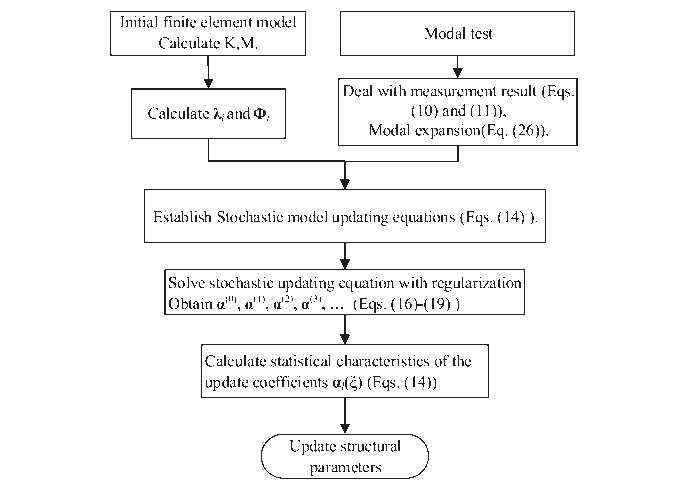
Under the supervision of Professor Bin Huang, doctoral student Hui Chen proposed a new framework for stochastic model updating based on stochastic finite element methods. The framework comprises the formulation and solution of stochastic model updating equations. The paper solves these equations using the stochastic perturbation–Galerkin method developed by the group. Compared with Bayesian updating using Markov chain Monte Carlo sampling, the new method achieves high computational efficiency while maintaining updating accuracy.
Abstract
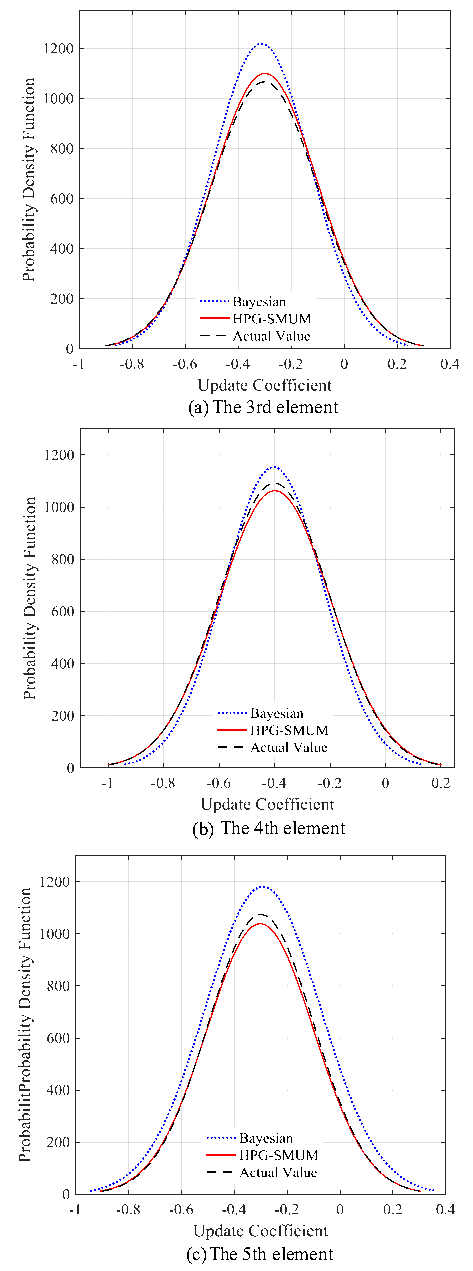
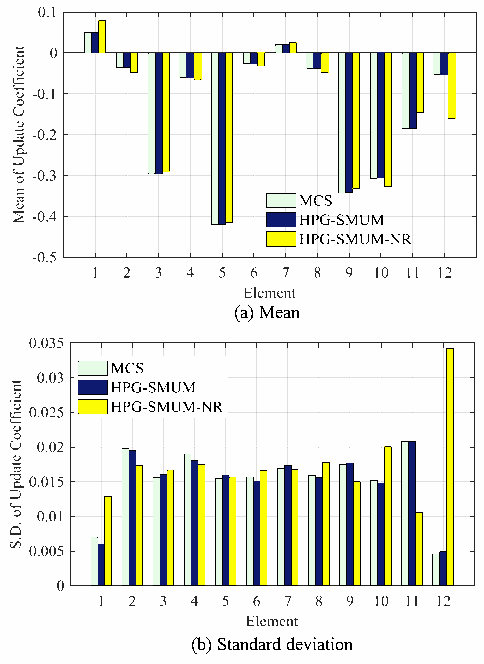
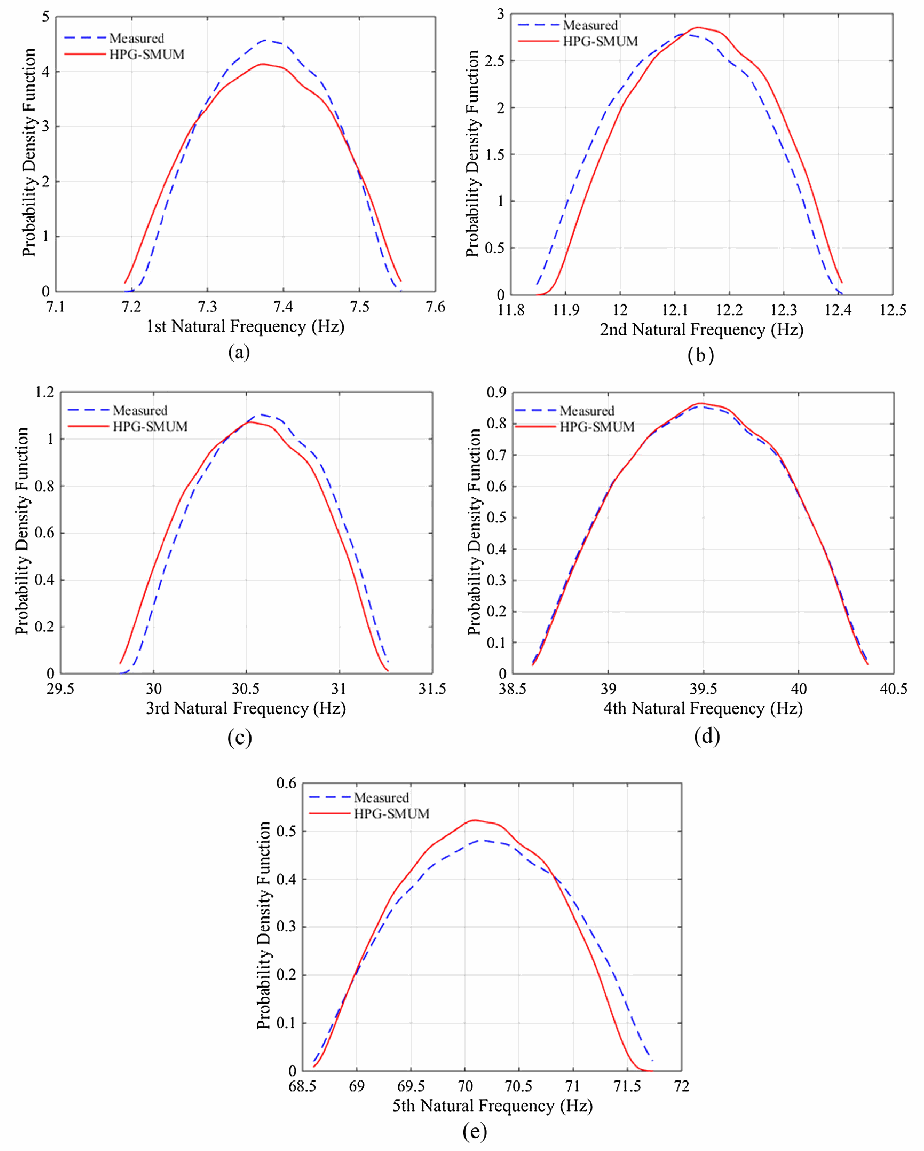
Finite element (FE) model updating uses reliable measurement data to modify an FE model and minimize discrepancies between simulated responses and measured data. However, measurement errors introduce uncertainty into the data and, consequently, into the updated structural model. This paper proposes a new stochastic model updating approach based on the hybrid perturbation-Galerkin stochastic finite element method. First, a set of stochastic model updating equations is established to explicitly describe the relationship between the updating coefficients and measurement errors. A high-order perturbation technique, based on a power series expansion, is combined with regularization to solve these equations. Perturbation terms of different orders in the updating coefficient vector are then used as basis vectors in a Galerkin projection to improve the approximation of that vector. The statistical characteristics of the updating coefficients can subsequently be obtained. Three numerical examples demonstrate the effectiveness of the proposed approach. The numerical results show that the proposed method achieves accurate results at a substantially lower computational cost than the Bayesian method used for comparison. Unlike the low-order perturbation method, it can address stochastic updating problems with large fluctuations in measurement errors. Even when only the first few modes are available and measurements cover an incomplete set of degrees of freedom, the statistics of the updated frequencies and mode shapes remain consistent with the simulated measurements.
Keywords: Stochastic model updating; Stochastic finite element method; Uncertainty; High-order perturbation; Galerkin projection scheme
Selected Figures
Citation
Huang, B., & Chen, H. (2019). A new approach for stochastic model updating using the hybrid perturbation-Garlekin method. Mechanical Systems and Signal Processing, 129, 1–19. https://doi.org/10.1016/j.ymssp.2019.04.012