
 中文
中文 English
Research Highlight
Stochastic stability analysis of dynamical systems with random parameters in the Lyapunov sense
SCIENTIA SINICA Physica, Mechanica & Astronomica · 2026
Innovation and Contributions
Under the supervision of Professor Bin Huang, master’s student Xiaolong Zhang made significant progress in the stochastic stability of nonlinear dynamical systems with random parameters. Part of this research was published in Volume 56, Issue 7 (2026) of SCIENTIA SINICA Physica, Mechanica & Astronomica. The paper extends the theory of stability of motion for general dynamical systems introduced by Lyapunov in 1892 from deterministic systems to systems with random parameters, establishing a theoretical foundation for analysing the stochastic stability of nonlinear systems with random parameters.
Building on the definition of stochastic stability, the paper develops a theory and methods for stability analysis in the Lyapunov sense. It formulates and proves a theorem giving sufficient conditions for stochastic asymptotic stability, establishes a theorem on stochastic boundedness, and formulates and proves a theorem on stochastic instability for dynamical systems with random parameters.
Abstract
Based on the definition of stochastic stability, this paper proposes a method for analyzing the stochastic stability of dynamical systems with random parameters in the Lyapunov sense. By combining probabilistic methods with Lyapunov’s direct method, a theorem establishing a sufficient condition for stochastic asymptotic stability is formulated and proved. A stochastic boundedness theorem is also established, extending the analysis from stability about an equilibrium point to boundedness without reference to an equilibrium point. In addition, a theorem on stochastic instability is formulated and proved. Two numerical examples examine a Duffing system with random parameters and a parametrically excited system with random parameters. The results demonstrate the effectiveness of the proposed method.
Keywords: dynamical systems with random parameters; Lyapunov direct method; probabilistic method; stochastic asymptotic stability; stability criterion
Selected Figures
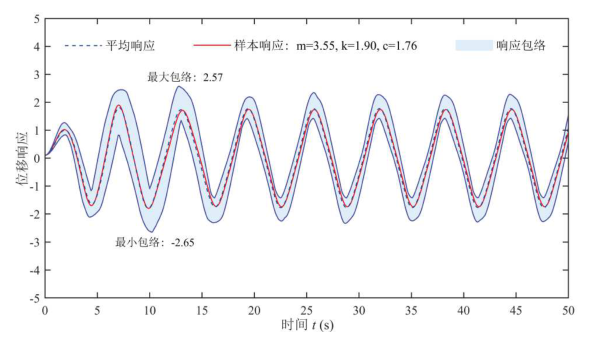
![Figure 2. Mean displacement response E[x(t)] of the Duffing system with random parameters under different initial conditions.](../assets/papers/stability/figure-2.png)
Citation
Huang B, Zhang X L. Stochastic stability analysis of dynamical systems with random parameters in the Lyapunov sense (in Chinese). Sci Sin-Phys Mech Astron, 2026, 56: 274512. doi: 10.1360/SSPMA-2025-0434.